5 B2B Pricing Strategies for Shopify
Pricing is the single biggest lever for B2B revenue. A 1% improvement in pricing can translate to an 11% increase in operating profit, according to McKinsey pricing research. Yet most Shopify merchants use the same flat discount for every wholesale customer. Here are five pricing strategies that go beyond the basic “20% off for everyone” approach.
Strategy 1: Tiered Customer Discounts
The simplest and most common wholesale pricing model. You assign different discount levels to different customer groups based on their relationship, volume commitment, or loyalty.
How it works:
- Silver tier (new wholesale accounts): 10% off
- Gold tier (established accounts, $5K+ monthly): 20% off
- Platinum tier (top accounts, $20K+ monthly): 30% off
Why it works: tiered pricing rewards loyalty and incentivizes buyers to increase their order volume to reach the next tier. It also gives you room to negotiate with new accounts (“start at Silver, and we’ll move you to Gold after 3 months of consistent orders”).
How to implement on Shopify: use customer tags (silver, gold, platinum) and create a separate wholesale rule for each tier in Wezy. Each rule applies its own discount percentage to the same product catalog.
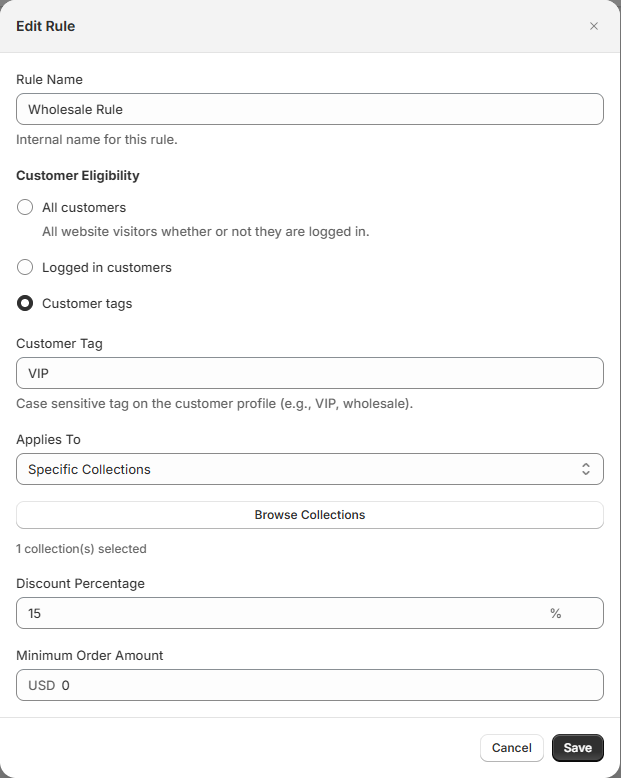
Tiered customer discounts work best for merchants with 3 or fewer pricing levels. If you need more granularity, consider catalog-based pricing or individual negotiation.
Strategy 2: Volume-Based Pricing (Quantity Breaks)
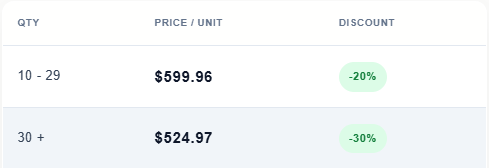
Instead of discounting based on who the customer is, volume pricing discounts based on how much they buy. The more units they add to the cart, the lower the per-unit price.
Example for a product retailing at $100:
| Quantity | Discount | Price Per Unit |
|---|---|---|
| 1-4 | 0% | $100 |
| 5-9 | 10% | $90 |
| 10-24 | 15% | $85 |
| 25+ | 20% | $80 |
Why it works: volume pricing directly incentivizes larger orders. Buyers can see exactly how much they save by adding more units, which creates a natural upsell mechanism. It also simplifies conversations because the pricing is transparent and self-serve.
How to implement on Shopify: Wezy’s Volume Pricing feature lets you define quantity breaks per product or collection. The volume table displays directly on your product pages, so buyers can see the tiers before adding to cart.
Strategy 3: Request for Quote (RFQ)
For high-value orders, custom products, or complex B2B deals, fixed pricing doesn’t always work. A request-for-quote workflow lets buyers submit their requirements and negotiate terms before placing an order.
How it works:
- The buyer browses your catalog and clicks “Request a Quote” instead of “Add to Cart”
- They specify quantities, variants, and any special requirements
- You review the request and respond with a custom quote
- The buyer approves the quote, and a Shopify order is created automatically
Why it works: RFQ is essential for merchants who sell custom, made-to-order, or high-ticket items where standard pricing doesn’t apply. It also builds relationships because the negotiation process creates a personal connection with B2B buyers.
Best for:
- Custom or personalized products
- Orders above $5,000
- Products with variable costs (raw materials, seasonal goods)
- New wholesale relationships where you want to vet the buyer first
How to implement on Shopify: Wezy’s Request a Quote app adds an RFQ button to your product pages and manages the entire negotiation workflow from your Shopify admin.
Strategy 4: Collection-Based Pricing
Not all products have the same margin. Instead of applying a blanket discount across your entire catalog, assign different discounts to different collections.
Example:
| Collection | Wholesale Discount | Reason |
|---|---|---|
| Accessories | 25% | High margin, impulse buys |
| Core Products | 15% | Standard margin |
| Premium Line | 10% | Low margin, high perceived value |
| Clearance | 40% | Moving old inventory |
Why it works: collection-based pricing protects your margins on premium or low-margin products while staying competitive on high-margin categories. It also lets you use discounts strategically, for example, offering deeper discounts on accessories to incentivize bundle purchases.
How to implement on Shopify: in Wezy, create separate wholesale rules for each collection. Set the “Applies To” field to the specific collection and define the discount percentage. You can even combine this with customer tags for maximum flexibility (e.g., Gold-tier customers get 25% on accessories, Silver-tier gets 15%).
Strategy 5: Minimum Order Thresholds
Setting minimum order requirements is a pricing strategy in itself. It filters out low-value orders, ensures profitability per transaction, and signals that you’re a serious wholesale supplier.
Two types of minimums:
- Minimum order amount: the cart total must exceed a specific value (e.g., $500 USD)
- Minimum order quantity: the cart must contain at least a certain number of items (e.g., 24 units)
Why it works: without minimums, you’ll spend the same operational cost processing a $50 order as a $5,000 order. Minimums ensure every wholesale transaction is worth your time and aligns with your fulfillment capacity.
Pro tips for setting minimums:
- Calculate your break-even point per order (packaging, shipping, processing time) and set your minimum above it
- Start with a lower minimum for new accounts and increase over time
- Consider different minimums for different customer tiers (lower for Platinum, higher for Silver)
- Display the minimum requirement clearly on your wholesale landing page to avoid frustration
How to implement on Shopify: in Wezy, each wholesale rule has optional “Minimum Order Amount” and “Minimum Order Quantity” fields. Set these based on your operational costs and margin targets.
Combining Strategies for Maximum Impact
The most effective B2B pricing doesn’t rely on a single strategy. Here’s how successful Shopify merchants combine them:
The “Good-Better-Best” stack:
- Base layer: tiered customer discounts (Silver/Gold/Platinum)
- Incentive layer: volume pricing on key product lines
- Protection layer: minimum order requirements
- Flexibility layer: RFQ for large or custom orders
This gives you structure for standard orders while maintaining flexibility for exceptional situations.
Example in practice:
A Gold-tier customer browsing your store sees:
- Their 20% wholesale discount on all products (tiered pricing)
- An additional volume table showing 5% extra off for 25+ units (volume pricing)
- A “Request a Quote” button for orders over $10,000 (RFQ)
- A notice that minimum order is $500 (threshold)
Frequently Asked Questions
Which pricing strategy works best for small Shopify stores?
Start with Strategy 1 (tiered customer discounts). It’s the simplest to set up and manage. As your B2B operation grows, layer in volume pricing and minimums.
Can I use multiple pricing strategies at the same time?
Yes. Wezy supports multiple wholesale rules running simultaneously. You can have different rules for different customer tags, collections, and conditions. They work independently and stack as needed.
How do I know if my wholesale pricing is profitable?
Calculate your contribution margin per wholesale order: (Revenue - COGS - Shipping - Processing costs) / Revenue. If this number drops below 15-20%, your wholesale discount is too aggressive. Adjust your tiers or increase minimums.
Should I show wholesale prices publicly on my store?
Generally, no. Keep wholesale prices visible only to logged-in, tagged customers. Showing wholesale prices publicly can undercut your DTC pricing and create channel conflict with retail partners.
What’s Next?
- Implement your first strategy with our wholesale pricing setup guide
- Understand the difference between native B2B and apps
- Learn about Shopify Functions powering these strategies
- Read our complete guide to selling wholesale on Shopify
- Explore RFQ vs fixed pricing to find your ideal model