RFQ vs Fixed Pricing for Shopify B2B
Every B2B merchant faces the same question at some point: should you publish fixed wholesale prices, or should buyers request a quote? The answer isn’t always obvious. Both models have clear advantages, and many successful merchants use a combination of both. Let’s break down the differences so you can make the right call for your Shopify store.
What Is Fixed Wholesale Pricing?
Fixed pricing means every eligible customer sees the same pre-set wholesale price. You define the discount upfront (e.g., 15% off for customers tagged wholesale), and the system applies it automatically. No negotiation, no back-and-forth, no waiting.
Example: A customer tagged as VIP visits your store, sees that a $100 product is listed at $85 for them, adds it to cart, and checks out. The entire transaction is self-serve.
What Is Request for Quote (RFQ)?
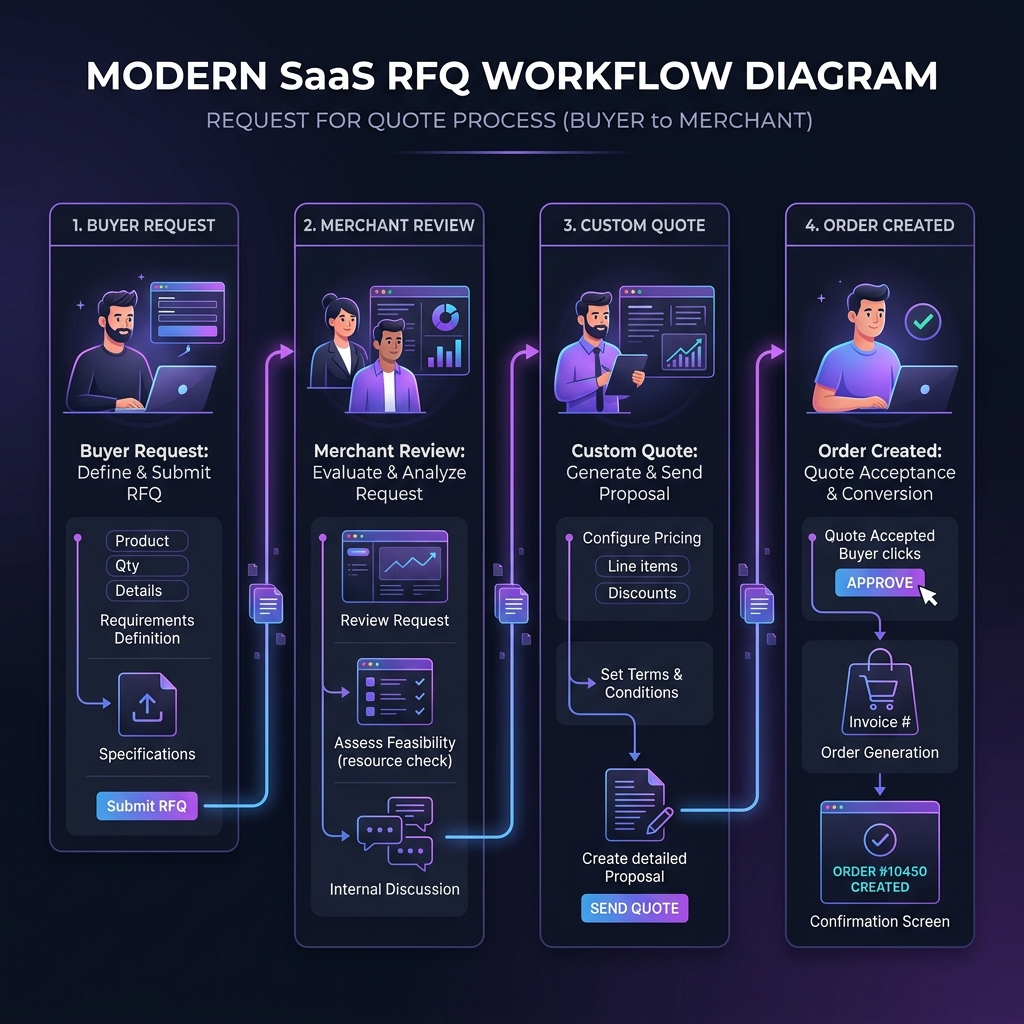
RFQ is a negotiation-based model. Instead of displaying a fixed price, you replace the “Add to Cart” button with a “Request a Quote” button. The buyer specifies what they want (products, quantities, special requirements), and you respond with a custom price.
Example: A buyer selects 500 units of a product, submits a quote request with a note asking for custom packaging. You review the request, calculate a bulk price, and send back a formal quote. The buyer approves it, and a Shopify order is created automatically.
Side-by-Side Comparison
| Factor | Fixed Wholesale Pricing | Request for Quote |
|---|---|---|
| Speed | Instant checkout | 24-48h negotiation cycle |
| Scalability | Handles unlimited orders without manual work | Each quote requires human review |
| Flexibility | Same price for everyone in a tier | Custom pricing per order |
| Buyer experience | Self-serve, fast, predictable | Personal, relationship-driven |
| Best for | Standard products with known margins | Custom, high-value, or variable-cost products |
| Operational cost | Very low (fully automated) | Higher (sales team involvement) |
| Trust building | Less personal | Builds stronger B2B relationships |
| Price sensitivity | Transparent (buyers know the price upfront) | Allows price discovery and negotiation |
When Fixed Pricing Is the Right Choice
Fixed wholesale pricing works best when:
Your products are standardized. If you sell the same product to every wholesale customer at the same margin, there’s no reason to negotiate. A t-shirt brand selling blanks to screen printers is a perfect example. The price is the price.
Your margins are consistent. When your cost of goods doesn’t fluctuate significantly, you can set wholesale prices with confidence. There’s no risk of quoting too low because your costs are predictable.
You want a self-serve experience. B2B buyers increasingly expect the same convenience as B2C shopping. A survey by McKinsey on B2B e-commerce found that 70% of B2B buyers prefer digital self-service. Fixed pricing delivers that.
Your order volume is high. If you’re processing dozens of wholesale orders per week, manually quoting each one isn’t sustainable. Fixed pricing lets you scale without adding headcount.
You have multiple customer tiers. With customer tags, you can easily create Silver/Gold/Platinum pricing tiers that apply automatically. Each customer group gets their pre-defined discount without any manual intervention.
When RFQ Is the Right Choice
Request for Quote works best when:
Your products are customizable. If buyers can choose custom colors, sizes, materials, or packaging, the price depends on their specifications. A furniture manufacturer or a promotional products company needs RFQ because each order is unique.
Order sizes vary dramatically. When one buyer might order 50 units and another might order 50,000, a single fixed discount doesn’t make sense. Volume at that scale requires custom pricing that accounts for production runs, shipping logistics, and inventory planning.
Your costs fluctuate. If your raw material costs change frequently (metals, fabrics, agricultural products), fixed pricing can eat into your margins during cost spikes. RFQ lets you adjust pricing per order based on current costs.
You want to vet new buyers. RFQ acts as a natural gating mechanism. You can review who’s requesting quotes, check their business credentials, and decide whether to approve them as a wholesale customer before any money changes hands.
You sell high-ticket items. For products above $5,000 per order, buyers typically expect a conversation. Nobody places a $50,000 order through a standard checkout without talking to someone first.
The Hybrid Approach: Using Both
The most sophisticated B2B merchants don’t choose one model exclusively. They use both, applied to different situations:
Model 1: Fixed Pricing + RFQ Threshold
Use fixed wholesale pricing for standard orders and add an RFQ option for orders above a certain value.
- Orders under $5,000: self-serve with fixed 20% wholesale discount
- Orders above $5,000: “Request a Quote” button appears for custom pricing
This captures the efficiency of fixed pricing for routine orders while offering flexibility for large deals.
Model 2: Fixed Pricing + RFQ by Product Type
Apply fixed pricing to your standard catalog and RFQ to custom or premium products.
- Standard products (collections): fixed wholesale discount
- Custom/bespoke products: RFQ only
- Premium limited editions: RFQ with minimum order requirements
Model 3: RFQ for New Customers, Fixed for Established
Use RFQ as a vetting process for new wholesale accounts, then transition approved buyers to fixed pricing.
- New buyer submits a quote request (you review their business)
- After 2-3 successful orders, you tag them as
wholesaleand apply automatic fixed pricing - They can still request quotes for large or custom orders
This is great for building trust while eventually scaling to a self-serve model.
How to Implement Both on Shopify
With Wezy’s app ecosystem, you can run both models simultaneously:
For fixed wholesale pricing: use Wezy Wholesale & Volume Discounts to create tag-based or login-based pricing rules. Discounts apply automatically at checkout via Shopify Functions.
For Request for Quote: use Wezy Request a Quote to add an RFQ button to your product pages. Manage the entire quote lifecycle (request, negotiation, approval, order creation) from your Shopify admin.
Both apps work independently and don’t conflict with each other. A customer can see their wholesale price on one product and have an RFQ button on another, all on the same storefront.
Frequently Asked Questions
Can a customer have both fixed pricing and RFQ access?
Yes. A customer tagged wholesale can see their automatic discount on standard products while also having the ability to request quotes on custom or high-value items. The two systems are completely independent.
Does RFQ slow down my sales process?
It adds a step, yes. But for high-value B2B transactions, that step often increases conversion because it gives the buyer confidence that they’re getting a fair price. The key is to respond quickly. Aim for same-day quote responses.
What if a buyer tries to negotiate below my minimum margin?
With RFQ, you have full control. You can counter-offer, set a minimum quote value, or simply decline. Unlike fixed pricing, RFQ gives you the power to say no to unprofitable deals.
Which model generates more revenue?
It depends on your business. Fixed pricing generates more volume (lower friction). RFQ generates higher average order values (personalized pricing). The hybrid approach typically outperforms either model alone because it captures both small routine orders and large negotiated deals.
What’s Next?
- Set up fixed wholesale pricing with our step-by-step guide
- Explore all 5 B2B pricing strategies for Shopify
- Read the complete guide to selling wholesale on Shopify
- Understand Shopify Functions and why they matter